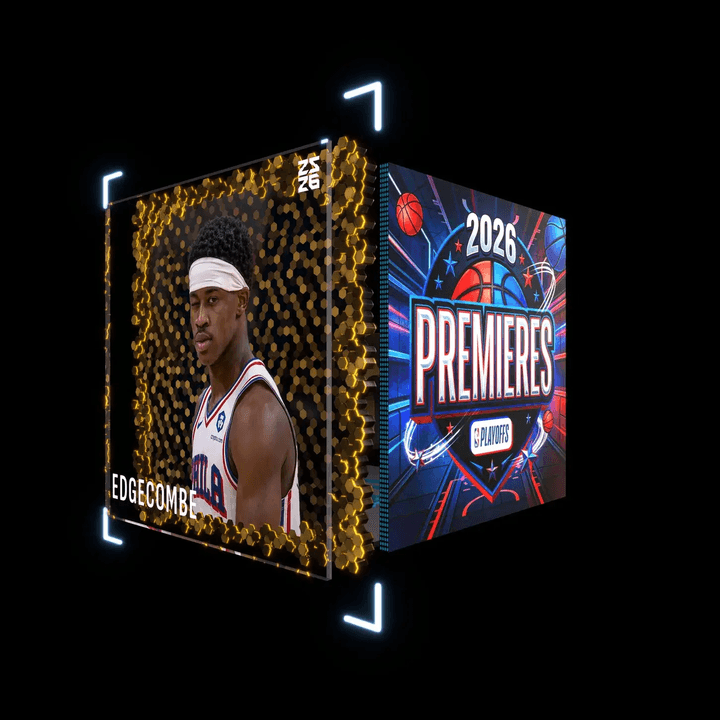
On the night of April 21, VJ Edgecombe became the youngest player in NBA history to post 30 points and 10 rebounds in a playoff game. He's the first rookie to do it since Tim Duncan in 1998. He did it on the road, in Boston, with Joel Embiid in street clothes and Philadelphia's season tilting on whether a 20-year-old could absorb the moment.
He could. Then he winked at the camera.
Less than 18 hours later, Top Shot opened the first activation of the 2026 Playoff Premieres burn-to-earn set — a structurally novel sink mechanic that the platform announced on April 14 as part of its broader playoff framework. The Edgecombe event is the first real-world test of the design. It's also, as of this writing, still in flight: the Jukebox auction closes with all ten slots contested and a top bid that implies collectors are willing to burn nearly $600 in Rare supply for a single /10 parallel.
This is the post about what the burn is actually doing to the Edgecombe Rare market, why the design appears to be working, and what it implies for the rest of a playoff run that could see this same player trigger the mechanic again.
Disclosure: I'm currently the high bidder on one of the ten Jukebox slots discussed below. Take everything that follows with that in mind. The burn cost I'm willing to absorb is itself a data point in the analysis.
The Mechanic in One Paragraph
The 2026 Playoff Premieres set is earned exclusively through burning. There is no direct sale path. When a rookie has a standout playoff Moment, Top Shot opens a 1-for-1 trade-in (up to 129 spots, first-come-first-served) where collectors burn any Rare of that player and receive the new Playoff Premiere Rare in return — net supply change zero. The next day, parallel auctions open: a Hexwave /25 and a Jukebox /10, with each slot won by burning multiple Rares of that player. Net supply change deeply negative.
The asymmetry matters. The trade-in is a shuffle. The auctions are the sink. Anyone trying to read this program for its supply effects has to look past Day 1 entirely.
The Edgecombe Population Damage
Here is what's happened to Edgecombe's existing Rare supply across the three sets where collectors are burning to participate. These are pre-event counts implied by the 129-per-set original mint, against current circulation:
Set | Original | Current | Burned | % Burned
Origins (Rare) | 129 | 89 | 40 | 31.0%
Metallic Gold LE (Rare) | 129 | 100 | 29 | 22.5%
Freshman Gems (Rare) | 129 | 93 | 36 | 27.9%
Total Rares | 387 | 282 | 105 | 27.1%
A caveat before the analysis: not every burn is attributable to the Playoff Premiere event. Some of these moments were burned earlier for Crafting Challenges, set rewards, or other incentives. But the burn velocity is overwhelmingly concentrated in the last 72 hours, and the distribution across sets — heaviest on Origins, lightest on Metallic Gold LE — is exactly what you'd predict if collectors were optimizing for the cheapest qualifying Rare to feed into the trade-in and the auctions.
That last point is the one most people will miss, and it's where the floor compression story actually starts.
The Selection Effect
Collectors burning into a Playoff Premiere event are not burning randomly. They are burning the cheapest Rare they own — or the cheapest Rare they can buy on the market specifically for the purpose of feeding the burn. That means the burn pressure lands disproportionately on the lowest-floor set, while the higher-floor sets survive.
In Edgecombe's case, the Origins Rare carried the lowest pre-event floor and absorbed the heaviest damage (40 burns, 31% of supply gone). Metallic Gold LE — historically the cleaner-design, higher-floor Rare for this rookie class — took the lightest damage (22.5%). Freshman Gems sits in the middle.
This produces two compounding effects on the surviving Rare population:
Mechanical floor lift on the burned-into sets. When you remove 40 of 129 listings, the listings that remain are by definition the higher-conviction holders. Sellers who would have folded at the old floor have already been bought out and burned. The new floor is a higher-conviction floor.
Pricing pressure on the un-burned sets. Once Origins floors lift, Metallic Gold LE and Freshman Gems become the next-cheapest Rare a collector would feed into a future event — including the next Edgecombe Playoff Premiere, if he triggers one. That's a forward-looking demand signal that's difficult to fade.
The cleanest read: the post-burn Rare floor is higher than the pre-burn floor not just because supply is lower, but because the price-insensitive holders are the ones still standing.
The Hexwave Tier: Already Spent
The Hexwave /25 auction has already closed, and the supply effect is publicly visible:
Origins Hexwave: 25 → 23 (8% gone)
Metallic Gold LE Hexwave: 25 → 23 (8% gone)
Freshman Gems Hexwave: 25 → 20 (20% gone)
A 20% supply cut on the Freshman Gems Hexwave is a structurally important number. /25 parallels are already scarce by Top Shot standards; cutting one of them by a fifth in 48 hours, with a single rookie game as the catalyst, is the kind of move that gets noticed by holders of every other rookie's Hexwave parallels too. If you own a Cooper Flagg or a Dylan Harper Hexwave and you are watching this, you are doing the math on what happens when your rookie has his own Edgecombe night.
That is the second-order behavioral effect of a well-designed sink: it doesn't just cut supply on the player who triggered the event. It re-prices conviction across the entire rookie class.
The Jukebox Auction: Live Price Discovery
The Jukebox /10 auction is the single most legible piece of data in this entire event, because it's an open market clearing in real time on what collectors are willing to pay — denominated in burn cost — for a /10 parallel of a rookie who has played exactly one elite playoff game.
As of this writing, all ten slots are contested, and the bid distribution looks like this:
Top winning bid: $592.80
Lowest winning bid: $219.30
Mean bid: $439.72. Median: $438.60.
Spread between the high and low: 171%.
A few observations worth pulling out:
The total burn cost across all ten slots, if every current bid holds, is $4,397.20 — and that's the floor of the burn impact, because each of those bids is composed of multiple Rares being burned. The two highest bids are publicly visible at three Rares each (the top slot is two Playoff Premiere Standard + one Origins Standard; the second is two Playoff Premiere Standard + one Metallic Gold LE Hexwave). If we assume an average of roughly three Rares burned per winning slot — conservative given the bid distribution — that's another ~30 Rares burned on top of the trade-in damage, with a non-trivial number of those being parallel Rares (Hexwave, Metallic Gold) rather than base.
The shape of the bid distribution itself is informative. The top three slots clear at $560-$594, then there's a notable cluster at $438.60 (three slots tied), then a long tail down to $219. That tells you the market has roughly three tiers of conviction:
Small group of collectors who think Edgecombe's Jukebox is materially undervalued and are willing to burn aggressively to acquire one
Median tier that has converged on a "fair price" of ~$440 in burn cost
Patient tail looking to win at a discount if a higher bidder folds
The 171% premium between the high bid and the low bid is the size of the conviction gap on a single rookie's playoff trajectory. That is a real number with a real signal.
Why This Is a Well-Designed Sink
Many have argued that Top Shot's biggest structural problem has never been supply, exactly — it has been theatrical scarcity: rarity tiers that don't translate into actual scarcity-driven price behavior, because the platform has never reliably destroyed supply in proportion to the rhetorical scarcity it markets.
The 2026 Playoff Premieres set is, structurally, the cleanest sink Top Shot has ever shipped. Four reasons:
1. Burns are demand-gated, not calendar-gated. The mechanic only fires when a rookie actually performs at a playoff level worth commemorating. There's no scheduled drain on supply that happens regardless of whether collectors care. Collectors only burn when they want what's being offered — which is the entire conceptual point of a sink that isn't punitive.
2. The 1-for-1 trade-in prevents pure dilution. The naive version of this program would be "give us a Rare and we mint you a new one" with no scarcity floor. The actual design caps the trade-in at 129 — the same edition size as the original mint — which means the Playoff Premiere edition can never exceed the size of a normal Rare set, and the burn-and-mint flow is exactly net-zero. This is the right design choice. It captures collector enthusiasm without inflating the Rare population.
3. The parallel auctions create burn multiplication without forcing it. Day 2 is opt-in. Collectors who just want the base Premiere can grab it at 1-for-1 and stop. Collectors who want the parallel can bid, and the bidding mechanic — burn cost rather than dollar cost — means the supply destruction scales with collector intensity rather than with what Dapper decides is "fair." The market sets the burn price. Dapper just provides the venue.
4. Asymmetric upside for non-participating holders. This is the part people miss. If you own an Edgecombe Rare and you do not participate in the burn, your position has been improved — the supply has shrunk around you and the floor has lifted. You get the scarcity benefit without spending a dime. That's how a sink is supposed to work for the holder base, and it almost never does in practice.
The combination of these four properties is rare enough that I think it's worth saying clearly: this is a mechanic where the marketed scarcity is being enforced by the structure of the program itself rather than by Dapper's promises about future behavior.
The Recurring-Activation Risk (Or: Opportunity)
Here is where it gets interesting, and where I want to flag what I think is the most underpriced dynamic in the entire Playoff Premieres setup.
Edgecombe could trigger this mechanic again.
He plays for a 76ers team that just won Game 2 in Boston without Embiid. If he has another standout performance — a series-clinching shot, a 30-point Conference Semifinal night, anything that crosses Top Shot's "standout Moment" threshold — a new Playoff Premiere Moment opens. New trade-in. New Hexwave auction. New Jukebox auction.
The Rare supply that just absorbed a 27% cut will absorb another. The /25 Hexwaves that just lost 8-20% will lose more. And the collectors who just paid $4,400 worth of burns to win Jukebox slots will be looking at the same auction format on a new Moment.
This compounds in two directions simultaneously:
Bull case: Each successive activation tightens supply further on a non-linear curve. If Edgecombe has three Playoff Premiere triggers across this run — not absurd given his trajectory and Philadelphia's matchup — his Rare population could be cut by 60% or more from where it sat before the playoffs began. The collectors holding the surviving Rares would be sitting on a meaningfully different asset than the one they bought.
Bear case: Burn fatigue. The pool of collectors willing to feed the auctions is finite. By the third activation, the bid distributions could compress hard, the Hexwave and Jukebox auctions could clear at meaningfully lower burn costs, and the supply-destruction velocity could fall off a cliff even as the platform's marketing continues to hype each new event. The mechanic would still work — but the surplus value would shrink.
The single best falsifiability hook for whether this program is structurally sound is what happens to the second activation's Jukebox bid distribution relative to the first. If the median bid on Edgecombe's hypothetical second Jukebox holds at or above $438, the design is working — collectors are absorbing the increased burn cost because they actually believe in the long-term scarcity story. If the median bid drops materially, that's the market telling you the sink has a half-life and the program is closer to a one-shot novelty than a durable supply mechanism.
I'll be watching that number carefully, on Edgecombe and on every other rookie who triggers the mechanic this postseason.
What to Watch From Here
A few specific things I'd track if you're holding Edgecombe Rares, parallels of any rookie, or thinking about positioning ahead of the next round:
Floor behavior on the un-burned Edgecombe sets (Metallic Gold LE and Freshman Gems Standard). If the selection-effect thesis is correct, those should lift in the next 7-14 days as collectors who burned through Origins start refilling positions or as future-event speculators front-run the next activation.
The bid distribution on the next rookie's Jukebox auction. Knueppel, Castle, and Flagg are all live candidates for triggering events. The shape of those bid curves will tell you whether collector enthusiasm is concentrated on Edgecombe specifically or distributed across the rookie class.
Hexwave parallel floors across the rookie class. The fact that collectors are willing to burn a /25 Hexwave to win a /10 Jukebox slot is a signal about how the parallel hierarchy is actually being valued. If Hexwave floors compress while Jukebox floors expand, the relative-scarcity story is playing out as designed.
Closing
The 2026 Playoff Premieres set is, in my view, the strongest piece of evidence that Top Shot has a working answer to the question that has dogged the platform since 2022: how do you reconcile a marketed-scarcity narrative with a supply structure that, until now, has only ever expanded?
The answer is: make the destruction mechanism conditional on real-world performance, let the market price the burn cost, and make the supply effect asymmetrically rewarding for the holders who don't participate.
That is what's happening with Edgecombe right now. The numbers are real from all the burning schemes they've deployed this season. 105 Rares are gone. 9 Hexwaves are gone. 3 Jukeboxes are gone.
This is the most successful burning I've seen on the platform. Whether the design holds up across multiple activations, multiple rookies, and the long playoff grind is a question we're going to get answered very quickly: Dylan Harper is up on Monday.
I have skin in this game. I think it's a good design. I'd rather lose the auction and watch the program work than win it and watch the program fail.